Thursday, November 11, 2010

An Autumn Photo Walk

Carlo and Benni

On October 30, 2010, Jim Palik and I organized a photo walk in connection with the exhibition "The Turning". Even though it was his birthday and he was feeling under the weather, he gave a wonderfully informative talk on "The Art of Seeing and Visual Design", taking the dozen members of his audience through the basics of working with a camera and using it as a tool to create photographic art.
Then I spoke for a bit about photo walking in general, pointing out the important differences between walking alone - as I do most days - or taking part in a group walk. In the latter one often feels more inspired and less inhibited to take pictures of people out on the street. One question that came up during our discussion - and that one often reads about in various photo forums - is what about taking pictures of people in public? Some people get very nervous about doing it on account of legal reasons; others shy away because they themselves don't like being photographed. Of course, if you pick out one person to photograph and then sell that picture without the person's permission, there can be legal consequences. (I always wonder about the Vietnamese children in travel photographers' pictures. What kind of release do they sign?) But if someone is out at public in a parade (like the Christopher Street Day Parade) or a demonstration (S 21) and you take a picture of them, I doubt they can claim that their public sphere has been invaded if you post a picture of them on flickr or on your blog. So we set as one of our goals for the two-hour walk to ask one stranger if we could take their picture.
But first we walked through the weekly flea market at Karlsplatz. There our goal was to capture an image that exemplifies the feeling of being at this flea market. We saw some lovely handmade children's clothes, the normal collections of silverware and records, mounds of broken kids' toys and the fascinating assortment of shiny electronics that look like they might work - but probably don't. So my shot has a row of toasters in the front and a foreign woman in a head scarf in the background.

When we got over to the Schloßpark, where a huge demonstration had just passed through, we were watching some bare-chested young men jumping on a slack line. They didn't seem to mind in the least that photographers were taking pictures of them. There under the pedestrian bridge one has to think of where the troll lives in "Three Billy Goats Gruff" because it is dark and dank and the grass that was once there has been trampled to mud. In a word, it is gray. And as beautiful as the weather was that day (see later pictures), the light there didn't help the situation. Then my eye was caught by a colorful sweater and a nice smile. I took a couple of snapshots of her to try to show how well she stuck out in those gray surroundings. Then I thought of our goal, gathered up the courage and, for the first time, asked a stranger if I could take her picture. "Sure, what is it for?" That was a question I had warned everyone to have an answer for.
"For my blog. We're doing a photo walk in connection with my exhibition in the DAZ," I told her. "And I like the way you really brighten up this part of the park."

With the natural sunlight coming from her left, we got an awesome catch light in her eyes. She has my card. Perhaps she'll see this picture and contact me. Then I'll certainly ask if she would like to do a longer shooting with me. Right after I took a few pictures, her phone rang and I went on.
In the park, we were greeted by many photo ops thanks to the S 21 struggle. Being the day before Halloween, someone thought to bring the horror of that holiday into the discussion (K 21 means Kopfbahnhof 21, which purports to be a viable alternative to the extremely expensive underground station that has been planned now).
I love K 21


 It has been claimed that children have been exploited (German: instrumentalisiert) by their parents in demonstrating against the project. This girl's parents seem to have taken the accusation, or at least the word, literally. 

A girl marches to the beat of her own drum

When we arrived in the Schloßpark, the demonstration had already marched out, but my camera caught the tail end of what looks like a small protest, but there were 20,000 citizens marching.


Lost but not alone
 On the way back to the starting point, we saw some remnants of the march, including this lost green balloon.

Oben geblieben

Wednesday, November 3, 2010

Schlosspark
bay of sycamore leaves
would make a fine resting place
but Spot needs walking
Two hundred eighty-three trees in the park are going to be felled to make room for a subterranean train station. Fortunately, this beautiful avenue of century-old sycamore trees will remain standing. In the fall a veritable carpet of stunning orange foliage lines the north edge of the park.


Photographers can delight at every time of day, though the trees block the late afternoon sunlight across much of the park, allowing only streaks of the last rays into the belly of Stuttgart's green lung.
Karl - or Wilhelm?
heedless horseman, ride!
in your head the clouds stand still –
your steel steed’s hoofs fly
 Just in front of the DAZ is the Karlsplatz, where Saturday flea markets entice bargain hunters to the square of chestnut trees surrounding this memorial to Kaiser Wilhelm I. The square was named after Duke Karl Eugen in 1793, but the horse and rider have only been there since 1898, ten years after Wilhelm's death.

Statue, Esq.

autumn sunlight falls
as once a discus soared
then returned to earth
The changing seasons can be readily observed by watching static objects. What effect does the different light have on them? How do the colors around them change their appearance? How well do they fit into their surroundings? 
The one-armed discus thrower probably never thought he would be overseeing the feeding of the ducks by the reflecting pool in front of the opera house, but it doesn't seem to bother him much. At least I've never heard him complain.

this angel’s not stone
but a miracle waiting
to happen to you
One day last fall, I got off the streetcar at the Bergfriedhof on my way home from work and walked around there for the first time since I moved to Stuttgart in 2002. I had my new Panasonic Lumix DZ38 with me and was snapping around me left and right when the cemetery gardener slowly approached me and asked if I was looking for anything in particular. What ensued was perhaps the nicest spontaneous conversation I've had with a stranger since I've been in Germany. He told me about how he was the third generation in his family to look after that cemetery. I opened up and asked him questions about the graveyard, burials in Germany and renting a grave (in Germany you usually rent a grave for 20-30 years, then it is re-used after the coffin has decomposed). I believe he pointed out this little angel to me. 


This grave girl reminds me of the little mermaid in Copenhagen except that this statue is clothed. I love the colors that emerge from the different textures of bronze as the light falls on the metallic finish.
wet-maned lions’ roar
resounds across the plaza –
frozen statues stare
Finally, we move away from the cemetery and head back into the center of Stuttgart, where the regal lions guard the fountains at the Schlossplatz. Every camera-toting tourist who has ever been to the Swabian capital has taken a picture here, but what I liked about this shot is the dominant contrasting colors of blue and yellow and the - albeit static - interplay between the gaping kings of the jungle and the towering statues atop the grand palace.

Tuesday, November 2, 2010

Magic Potion
autumn’s dark juices
ooze at dusk – turning sour
summer's sweet nectar

This strand of blossoms blocked my way up the hill behind my house early one evening last fall. The spot meter obliterated the background, leaving only the white flowers. The two blossoms at the bottom, dangling by the faintest spider's thread, make it look as if they were falling into nothingness. The narrow depth of field adds to the magic of the image.
The abundance of natural wonders close to us is a photographer's dream. The ever changing seasons and weather conditions allow for new motifs every day. Wherever you are, great photos are just waiting to be taken!

Tuesday, October 26, 2010


The Mystery of the Missing Cat
prickly back arches –
black cat strays too far from home
skips back just in time

Down the hill from where I live there is a row of four mailboxes at the bottom of a path that seems to have only one house at the end of it. And on these mailboxes there stood a cat - a big, black, prickly scaredy-cat. With the metallic hairs on his tail and his back sticking straight up, he seemed to me to be the epitome of the typical Halloween cat. This picture was taken two weeks after Halloween last year. Sometime in September this year, I noticed that it was no longer there. Someone had apparently knocked it off. I've put an invitation to our exhibition in the mailboxes, explaining to them that a photo of their cat is hanging in the DAZ. If they get in touch with me, I'll let them have the picture.

The times and dates of our exhibition have been extended. There's still time to go see it!
Halloween
Hexe Lilith
 The whole magic of autumn - for Tiffany - revolves around Halloween, the evening before All Saints' Day. It was known as All Hallows' Evening and over the years was shortened to Hallowe'en. The holiday seems to be most fervently followed in the US, where some neighborhoods work up to it for months!

our leaf-thin children
scatter through the neighborhood
yelling “Trick or treat?”
The past several years - ever since our kids could dress up in costumes - we've gone trick-or-treating around the neighborhood. Last year we covered a big round through our old stomping grounds in Gaisburg. It seems that the teenagers there have also heard of Halloween. Several were spotted throwing eggs and sacks of flour at cars and houses. That's not the type of tradition I want to see develop here in Germany!
Otherwise, we had a nice walk through the streets and loads of treats to share once we got home.

Thursday, October 21, 2010

Autumna


proud Autumna mocks 
winter’s icy bitter breath
with her sweet colors

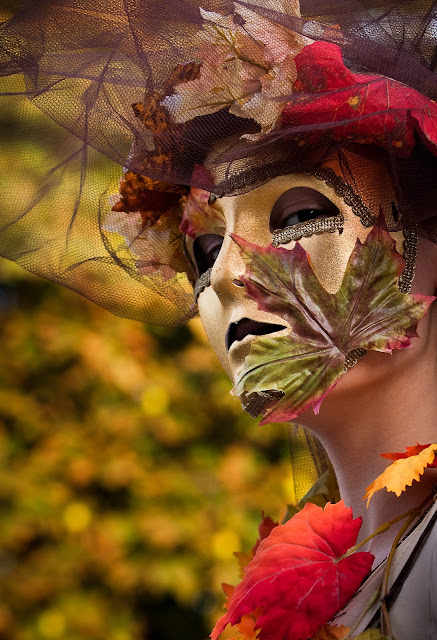
 This young woman walked in front of my camera at the Venetian Days in Ludwigsburg in September 2010. It was the right mixture of skilled setting up (so that the colors of the fall trees would be in the background of the picture) and a bit of luck. 
I took hundreds of pictures that day and on into the evening, but when I got home and saw this picture, I knew it had to be part of this exhibition. A few days after I took it, I went back to Ludwigsburg (10 km north of Stuttgart) and found her again. I asked her permission to use the picture and was graciously given permission. I wonder if she kept my card and went to see herself at the exhibition...


The Turning, Part 2

Shortly before the summer vacation 2010, there was a major amount of turn-over at the DAZ, where we were planning to exhibit our work. We had been given oral confirmations that everything would work out, but with Friederike leaving for Freiburg, we weren’t sure if things would work out; in our eyes she seemed too instrumental to the success of the show.
But then came Christiane Pyka and Miriam Bender, who have shown great support, enthusiasm and patience for our endeavor. A great teacher, Jim Palik spent a great amount of time and effort helping us mount and frame our pictures. He and his wife were very gracious with their time. 
Tiffany, Jim and Jane prepare a pastel print for framing

After having initial difficulties in making a selection, I was finally able to do so by narrowing down my choice of images to those that have some sort of magical, fairy-tale aspect to them so that they go well with Tiffany’s illustrations.
Tiffany teaches several English classes at local schools and has been able to involve her pupils in the project. Her vision of creating an autumn installation to complement the pictures has been realized. 

The Turning, Part 1

The Turning, Part 2

http://www.youtube.com/watch?v=l4O-QP9NkPw
My children helped make some of the decorations, as did Tiffany's son Nicola. Their school classes will come visit the show this week and hear Tiffany's story.
And now, for those of you who cannot make it to Stuttgart this October or November, we would like to present to you the pictures at our exhibition.
I'll start with the first three and then in subsequent posts present the rest.
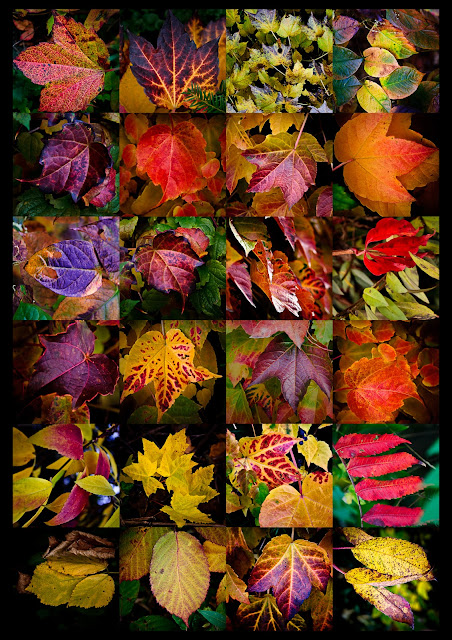
These mosaics or patchwork leaf pictures resulted from the thousands of leaf pictures I took during the fall of 2009. As the beautiful, long season progressed, I noticed the natural motifs changing from colorful trees and bushes full of leaves (as in the first picture) to single leaves hanging on the ends of bare branches.

Fall

fall’s warm color display
lines the way, captures eyes
with nature’s palette


Falling

one last leaf outlasts
November’s storm – those stubborn
frosty fingers!

Fallen

nestling communally–
a village of brotherly leaves –
then a great gust blows
I wrote haiku for most of the pictures in the exhibition and printed them all on a sheet of paper, with captions for Tiffany's pictures from her story on the back of the paper. Visitors are then asked to be active in searching for the picture that matches the poem or caption. Here I've done the work for you already.
For the German visitors (and for the part of me that likes composing in German), I wrote some haiku in German. For the three pictures above, the titles follow a linguistic progression of their own:

 herb

stacheliges Blatt!
genieße die Baumkrone
stolz und farbenfroh
herber
ihr langen Nächte –
naht und nagt an Stielen
mit eisigen Zähnen
herbst
gefallenes Blatt!
bald lassen kalte Winde
dir keine Ruhe 


Monday, October 18, 2010

Backtrack: Why photography? Why me? And why now?

I made my first photo book when I was in seventh grade. My father had given me a second-hand 120mm film camera that used those old single-use flash bulbs. Sometimes they worked and sometimes they didn’t. You had to put them in just right so that the contacts were touching the right part of the bulb. I think a roll of film cost about $1.25 for 12 pictures. Junk mail in those days often included mailers for photo processing. So I would send the long roll of film into the lab, paying about $2.50 for the development and printing, wait a week or 10 days and then be able to see which pictures had turned out. 


An excerpt from my first photo book, c. 1975

When I was in high school, Joei Barrios lent me one of her 35mm cameras, a Canon Ftb QL with a 55mm lens. That was my equipment for the next three years – no zoom, no flash, no tripod, but was blessed to be able to gain experience as a yearbook staff photographer and have the processing of hundreds of rolls of film paid for by the publications department of my high school

Californian artist Juana Olga "Joei" Barrios, 1980
I published hundreds of pictures and, as editor, learned to crop and layout the pictures. My mentor, Jim Coppens, was a great teacher with a very good sense of aesthetics. He also taught me to write and edit, two skills which help me keep bread of the table today.
Upon graduation from high school, my mother, who is an artist, traded one of her Georgia O’Keefe-style flower paintings for the Canon. Nothing Freudian about that, is there? Anyway, I was the guy with the camera in Europe, in college and in my first teaching job, where I worked as the adviser to the yearbook. There I taught the students everything I knew about event, group and sports photography, writing, editing, typing, layout design and artwork. On the side I taught German, American literature and computers and coached the soccer team. Over those four years I had the opportunity to photograph several weddings for family, friends and colleagues. They would buy 20 rolls of film, pay for the processing, let me pig out at the buffet and give me a backstage pass to the bride’s dressing room. That was fun!
My Canon was stolen one night by the school’s cleaning crew and before the insurance company could settle the case, I needed a new camera because I had to photograph a colleague’s wedding a couple of weeks later. So I bought a Nikon 4004s with a 28-85mm lens, a combination which was perfect for weddings and other events. I was given a flash as a present for taking pictures at one wedding, so that was my gear for the next ten years.
After moving to Germany, music became my means of artistic expression for a while, and photography remained a means of capturing memorable experiences with good friends. Some of my pictures from hikes in the Alps are “pretty” but I never really thought about creating artistic works of art with my camera.
Then came the children. And the first digital cameras. So I bought a 5 MP digital point-and-shoot Traveller from ALDI when my son was one. I had gained some experience with photo editing software in the meantime, so it was not difficult to make minor adjustments to my pictures before having them printed.
Then came Christian Ruvolo. I had known Christian for ten years by then. We had always enjoyed music and cooking together, but in 2007 he bought a Casio Exilim and discovered digital photography as an art form. He is a brilliant concert pianist, composer and all-around musician and does anything he really enjoys at a very high level of competence. When I visited him in Italy for capo d’anno (New Year’s Eve) in 2007-2008, he bought me a 7.2 MP Exilim because he saw how sad I was about my camera’s weak battery pack and inferior pictures.
Then he bought a Canon 450D.
Then I bought a Sony Alpha 300.
Then he bought two L lenses for his Canon.
Then I bought lots of cheap Sony/Minolta lenses on ebay.
Then he learned about flash photography.
Then I bought a Sony A700.
Then he bought a Canon 5D Mark IV.
Then I bought flashes and the Joe McNally book he recommended.
Then he bought more flashes and reflectors and umbrellas and California sun bouncers.
Then I bought reflectors and a big bounce and a third camera bag for my third Alpha.
Then he got his website going.
Then I started a photo blog.
Then he started doing incredible portraits of the music students where he teaches.
Then I did some portrait shoots and enjoyed it.
Then we photographed the same model here in Stuttgart (twice) and had a blast.
And we went on the Worldwide Photo Walk together with my son, his godson.
Now we share our day’s work via Skype. We critique each other’s work and give each other tips on post-processing. It’s been a symbiosis of the grandest kind.
Add to this chain of events the support of my friends who make me aware of photo contests and opportunities and of course the unfailing patience and support of my family and you get a somewhat accomplished photo-fanatic.

Friday, October 15, 2010

The Turning, Part 1

Autumna

The idea of doing an exhibition germinated last year just before Christmas, when Tiffany saw some of my photographs from autumn of 2009. She had just done an evening of Halloween storytelling at Starbucks which Fiona and I had enjoyed. We started brainstorming about how we might do it, and when we presented the idea to Friederike Schulte at the DAZ, she sounded enthusiastic about it.

Moonrise over Rotenberg

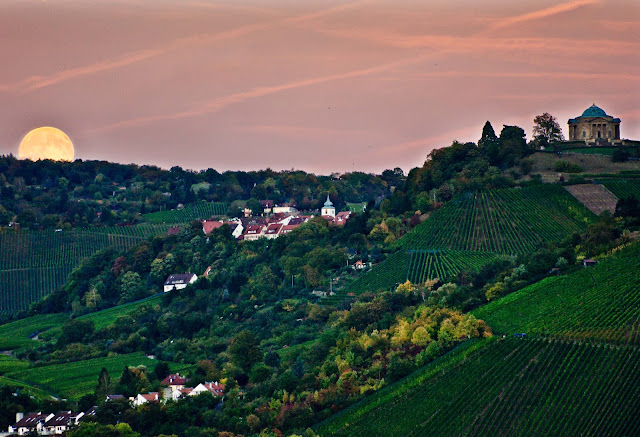
After I found out that an autumn moonrise picture of mine won second prize in the Stuttgart Marketing photo contest, I was encouraged to pursue the idea of an exhibit more seriously. Tiffany and I met with Thomas Kraut, who offered to help us along the way. He met with us several times, looked at the rooms, viewed my photographs and ultimately designed the wonderful invitations for us. He also is the father of the star of our show!

Lilith 

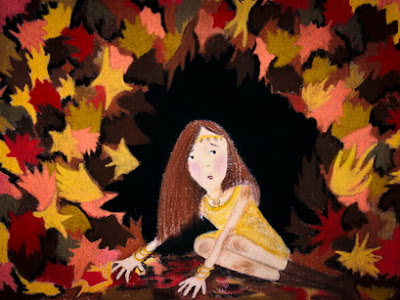
Tiffany and I met regularly to show each other our work. I read her story and shared my thoughts on it with her. She looked at my photographs and told me which ones she liked best. Her illustrations were partially inspired by my pictures.

Jamie in the leaf cave

Fall 

Another person who helped us tremendously was Jim Palik. We all knew each other from the writing workshop which we had been attending at the DAZ. Jim is a professional photographer who studied with Ansel Adams in California in the 1960s. When I got my first digital SRL in December 2008, I enthusiastically showed him the first selection of “good” pictures I had taken. He was very kind and patient in explaining how I could improve my photography.
Panorama in Beilstein

Over the next year, I learned a lot from him by seeing his exhibitions and those of his students from the HDM and by talking to him about photography. I also read and practiced a lot. I averaged about 3,000 pictures a month and post-processed nearly all the pictures with Adobe’s Lightroom software.

I still am not brave enough to use Photoshop, though I have taken some forays into some other software jungles such as Corel’s Paint Shop Pro and GIMP. In the past year I’ve learned how to do just about all the post-processing necessary in Lightroom. It’s not a perfect program, but I’ve learned to use it well.

Now a look back at my photographic history.

Sunday, September 19, 2010

Fynn turns 9

Let’s hear it, parents: “I can’t believe my baby boy is nine years old!!” Hmmm. Nine is just a number. He’s still the great little boy he’s always been. This summer he seems to have grown up quite a bit, though. After spending two weeks at day camp on the Marienburg on the hill behind our house, he went to a three-day soccer camp with 55 other boys and girls. The third day of the camp was his birthday, which he let the coaches know. That morning he was called into the middle of the circle and everyone sang “Happy Birthday” to him. I think this kind of high-focus attention would have driven him to tears a year ago, but he said he enjoyed it. Plus, they gave him an official EM 2006 soccer ball, a T-shirt and a big bag of gummi bears! I think it was nice for him to have a lot of attention on his birthday because we’re usually on vacation then, so he can’t have all his friends over. This year several of the friends he invited were on vacation themselves.


We celebrated his birthday the following Sunday. He wanted to play soccer with his friends at the Marienburg. First we ate cake and Fynn opened his presents. A new soccer ball! A VfB water bottle! A yard tennis set! All great presents. The wrapping paper from the ball was a big hit.


Bianca and I had set up a treasure hunt for him and his friends. On that hot August day, I rode around the neighborhood, drawing arrows on the sidewalk with chalk which showed them the way - sometimes the wrong way. At five appointed places, they had to find a yellow envelope with a task in it that they needed to solve before they would get the treasure. So with water bottles in hand (it was in the high 90s), they headed off on the big chase.
Fiona seemed to have the best eyes for finding the envelopes. And now that she can read, she was a big help in solving the mysteries.

After an hour of soccer, Bianca helped the boys learn a funny little poem by heart (one of the tasks) before they headed to the last stop on the hunt. In typical pirate fashion, the last clue was written in code, so they all helped break the code so that they could find the treasure chest, which was filled with bags of goodies.

And all the time Julia took it easy in the Baby Björn.

When we got back home, the boys had hot dogs and lots of juice before they headed home.
The Turning

I would like to invite you all to visit my exhibition in Stuttgart in October and November. The Deutsch-Amerikanisches Zentrum is hosting an autumn exhibit of works by Tiffany Estrada and me entitled "The Turning". It will be much more than just an exhibition, though. Storytelling, an installation and a photo walk on October 30 are all part of the fun. Come join us on October 14 at 6 p.m. for the grand opening or view the works on your own time Tue.-Fri. from 9-1 pm or 2-5 pm in the DAZ at Charlottenplatz 17. The show will hang until Dec. 3.